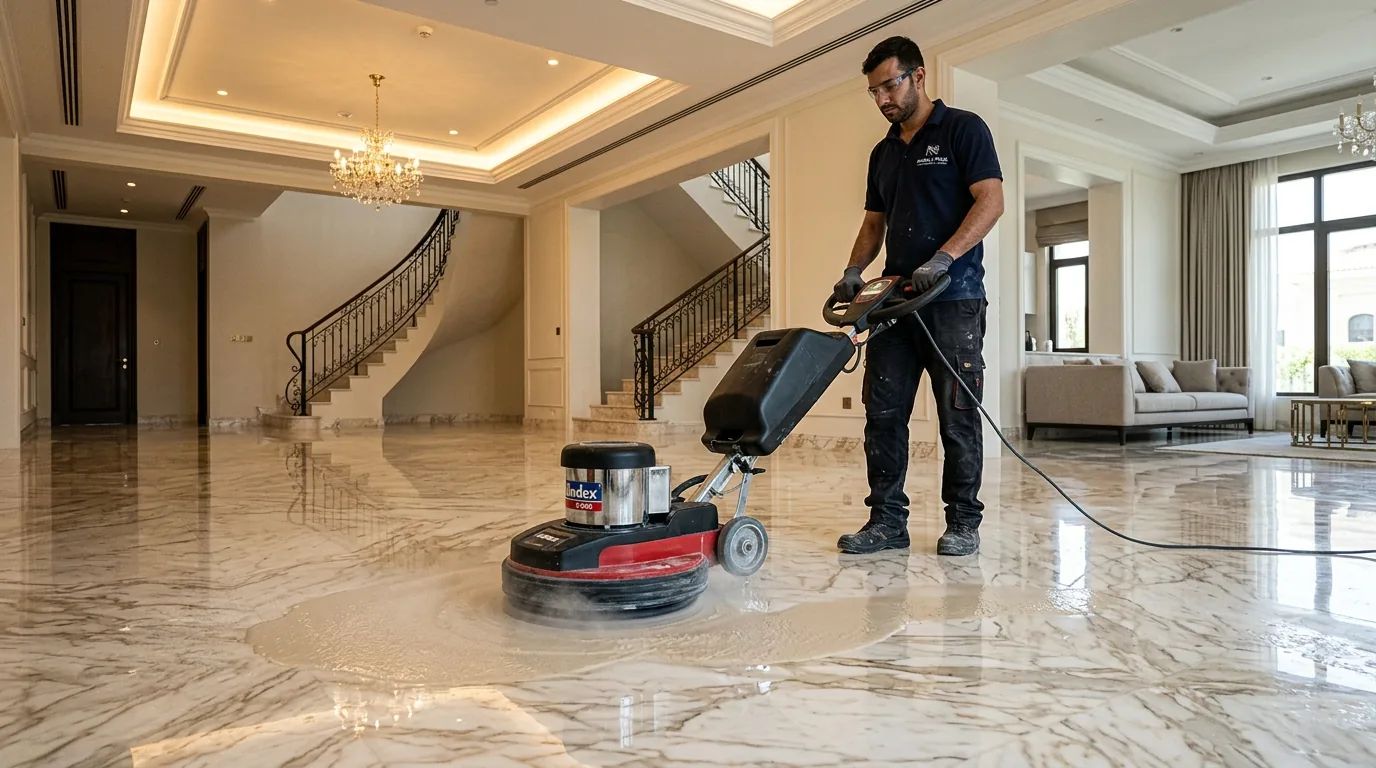
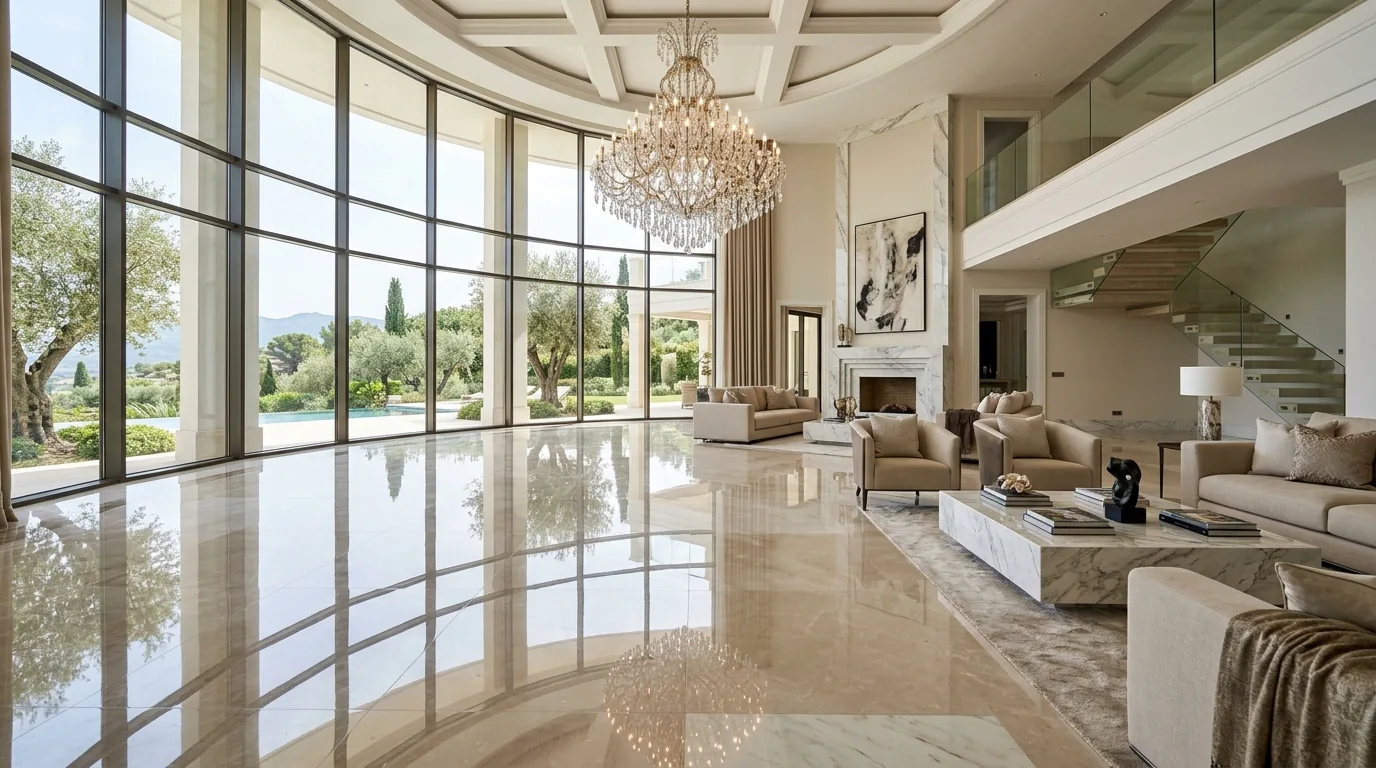
Transform newly laid tiles or aging natural stone floors into continuous, reflective architectural surfaces. Complete technical guide on industrial single-disc machine grinding, 8-stage diamond resin pads, lippage elimination, and thermochemical fluorosilicate crystallization across Karachi, Lahore, and Islamabad.
Rs. 25 – 65
Per Sq.Ft (Condition Dependent)50# to 3000#
Resin-Bond Micro Abrasion85 – 95 GU
High Optical ReflectionPlanetary Single-Disc
175–300 RPM Wet RotaryUnlike synthetic vitrified tiles with glazed ceramic surfaces, natural Pakistani marble—including Tavera Marble, Ziarat White, Sunny Grey, Badal Marble, and Boticina Cream—is a metamorphic stone composed predominantly of recrystallized calcium carbonate (CaCO₃).
True architectural polishing is not a layer of liquid wax spread on top of the stone. It is a dual process combining precision mechanical abrasives to flatten the crystal planes, followed by thermochemical crystallization that compacts microscopic pores into a vitrified, glass-hard calcium fluorosilicate surface layer.
Polishing rates vary depending on stone hardness, installation lippage, room geometry, and the grade of diamond pads employed. Below are the verified 2026 commercial and residential price benchmarks across major Pakistani metropolises:
| Polishing Method / Service Grade | Average Rate (PKR / Sq.Ft) | Ideal Stone Varieties | Execution Machinery | Durability / Lifespan |
|---|---|---|---|---|
| Basic Carborundum Stone Grinding (Sil Batti Ghisai) | Rs. 22 – Rs. 28 | Sunny Grey, Commercial Badal, Rough Tiles | Local single-phase hand machine | 12 – 18 Months |
| Standard 5-Stage Diamond Resin Polishing | Rs. 32 – Rs. 42 | Tavera Marble, Boticina Cream, Verona | Planetary buffer + 100#–1500# pads | 3 – 5 Years |
| Premium 8-Stage Italian Mirror Crystallization | Rs. 48 – Rs. 65 | Ziarat White, Badal Super, Luxury Living Areas | Heavy Italian rotary buffer + fluorosilicate | 6 – 8+ Years |
| Staircase Step Treads and Risers (Per Running Foot) | Rs. 40 – Rs. 75 | All varieties (Stairs Design Guide) | Variable-speed pneumatic edge grinders | Indefinite with re-buffing |
| Kitchen Slabs and Vanity Countertop Bullnose Buffing | Rs. 60 – Rs. 110 | Tavera, Granite, Ziarat White (Kitchen Tops) | Dry/Wet handheld diamond edge buffers | 5+ Years (Chemical Resistant) |
| Epoxy Joint Regrouting and Pinhole Filling | Rs. 8 – Rs. 15 | Porous beige marbles, antique floors | Tenax color-matched liquid mastic | Permanent integration |
Karachi (Manghopir, DHA, Clifton): Rates run competitive (Rs. 25–45/sq.ft) due to proximity to stone processing hubs, though high coastal humidity requires dedicated moisture testing before crystallization.
Lahore (DHA, Bahria, Gulberg) and Islamabad/Rawalpindi: Precision diamond crystallization averages Rs. 38–60/sq.ft, reflecting high demand for zero-lippage Italian machine finishing in modern luxury villas.
Achieving an authentic optical mirror finish requires rigorous grit progression. Skipping grit stages creates microscopic optical distortions and hollow reflections. Our industrial standard adheres strictly to the following 8-phase protocol:
Coarse metallic diamond segments shave down raised edges between uneven tiles, leveling the entire floor into a continuous, continuous planar surface.
Old cement lines and fine fissures are cleaned and pressure-filled with high-grade UV-stable epoxy mastic (Tenax/Akemi) precisely matched to stone veining.
Removes aggressive metal scratch patterns from Phase 1, leveling the filled epoxy joints flush with the natural stone face without dishing.
Closes open surface pores and refines the scratch geometry. At 400 grit, the stone develops a velvety satin sheen with initial light reflectivity.
Cleans away all remaining honing traces. Natural stone colors intensify, bringing out subtle cream veining in Boticina and beige undertones in Tavera.
Ultra-fine micro-abrasive pads polish the calcium carbonate matrix to an optical gloss, producing crystal-clear ceiling reflections before chemical treatment.
A magnesium/potassium fluorosilicate crystallization agent is buffed with a heavy 3M white or steel wool pad at 200 RPM, vitrifying the surface into a durable shield.
Deep-penetrating fluoropolymer impregnator is buffed into the stone, repelling tea, oil, cooking spills, and water absorption without changing surface texture.
Homeowners in Pakistan often encounter conflicting contractor proposals offering drastically different prices. Here is the technical breakdown of what each method actually delivers:
| Evaluation Parameter | 8-Stage Diamond Crystallization | Cheap Oxalic Acid Polish ("Acid Ghisai") | Wax Coating / Liquid Silicone Buff |
|---|---|---|---|
| Surface Flattening and Lippage | 100% Flat and Continuous (Metal bond diamond cuts stone flush) | Partial (Follows existing uneven slopes) | Zero (Cannot level tiles) |
| Gloss Longevity | 5 to 8 Years under standard residential use | 2 to 4 Months before turning dull and patchy | 3 to 6 Weeks; rubs off on shoe soles |
| Impact on Stone Health | Protective (Hardens surface layer into fluorite crystal) | Destructive (Acid corrodes calcite, causing micro-pitting) | Blocks natural respiration; traps yellowing moisture |
| Maintenance Routine | Neutral pH water mopping; annual dry micro-fiber buff | Requires frequent harsh chemical re-washing | Needs continuous waxing and stripping cycles |
| Slip Resistance (Dry) | High traction (Meets ASTM C1028 commercial friction specs) | Moderate | Hazardous when wet or dusty |
Contractors offering rock-bottom rates (Rs. 15–18/sq.ft) frequently replace diamond honing with raw oxalic acid or hydrochloric solutions. While acid provides an instant blinding gloss within 10 minutes, it chemically dissolves the top micro-layer of calcium. Within weeks, the pores reopen, trapping grease, dirt, and shoe scuffs permanently into the stone body.
Every quarry deposit exhibits distinct mineralogical hardness, calcite density, and porosity. Applying a generic polishing routine damages delicate stones. Below are tailored protocols for Pakistan's leading architectural marbles:
Critical Rule: Requires 100% white cement bedding and non-staining white diamond resin pads. Using recycled carborundum stones or iron-contaminated pads deposits metallic rust traces that ruin its pure white backdrop. Keep pad speed moderate to prevent localized heat scorch marks.
Critical Rule: Dense and structurally sound, Tavera accepts fine 3000-grit diamond reflection exceptionally well. Use translucent beige epoxy resin to fill micro-veins during Step 2. Maintain continuous wet slurry flushing to prevent dry friction pitting.
Critical Rule: Boticina has rich calcite veining with varied hardness between the cream matrix and brown veins. Requires balanced multi-head planetary buffers so the machine does not hollow out softer vein deposits while grinding the denser cream areas.
Critical Rule: These high-density calcitic stones feature distinct charcoal streaks. Heavy-duty 50-grit metal bonds are essential during initial lippage cutting. Once honed to 1500 grit, fluorosilicate crystallization achieves an astonishing obsidian-like contrast reflection.
Real-world execution data from our industrial stone restoration teams across Pakistan:
The newly installed Tavera marble floor exhibited noticeable height mismatches between slabs due to uneven screed bedding. Our crew deployed dual-head 4kW planetary grinders with 30# copper-matrix diamond discs to level all joints flush. Followed by 7-stage resin diamond buffing and thermal crystallization, the atrium achieved an unbroken glass-like reflection capable of withstanding heavy daily executive traffic without scuffing.
The client’s 6-year-old Ziarat White living room floor had lost its sheen due to acidic floor detergents. We performed deep surface de-waxing, fine diamond honing up to 3000 grit, and hand-finished 38 round stair treads with variable-speed bullnose pads. Completed with an oleophobic penetrating nano-seal, the marble regained 100% of its pristine quarry-bright brilliance.
Direct, factual answers regarding costs, diamond pads, curing timelines, and maintenance: