Live Market Tavera Marble (Lahore/Rawalpindi): PKR 240 - 290/sq.ft
Tavera (Karachi Manghopir): PKR 230 - 270/sq.ft
Ziarat White Super: PKR 520 - 680/sq.ft
Sunny Grey Commercial: PKR 130 - 170/sq.ft
Sunny White Calibrated: PKR 175 - 235/sq.ft
Badal Standard: PKR 145 - 180/sq.ft
Verona Cream: PKR 210 - 260/sq.ft
Export FOB 20ft Container Slabs: $17.50 - $24.00/m²
Live Market Tavera Marble (Lahore/Rawalpindi): PKR 240 - 290/sq.ft
Tavera (Karachi Manghopir): PKR 230 - 270/sq.ft
⚖ Architectural Flooring and Thermal Performance Analysis

Marble vs Tiles in Pakistan: 2026 Price Per Sq Ft, Structural Durability and Rooftop Heat Insulation

Building a 5-marla, 10-marla, or 1-kanal home in Pakistan? Discover the definitive breakdown between quarry-cut natural marble and glazed porcelain/ceramic tiles. Compare raw material rates, installation masonry, thermal comfort during summer heatwaves, and 50-year life-cycle costs.

Material Cost (PKR)

Rs. 75 – 320

Marble vs Rs. 180–450 Porcelain

Thermal Comfort

Cold Underfoot

Natural Heat Sink vs Hot Glaze

Floor Seam Aesthetic

Continuous Slab Surface

0mm Lippage vs 3mm Grout Lines

Design Lifespan

50+ Years

Infinite Re-polishing vs 10-Yr Tile
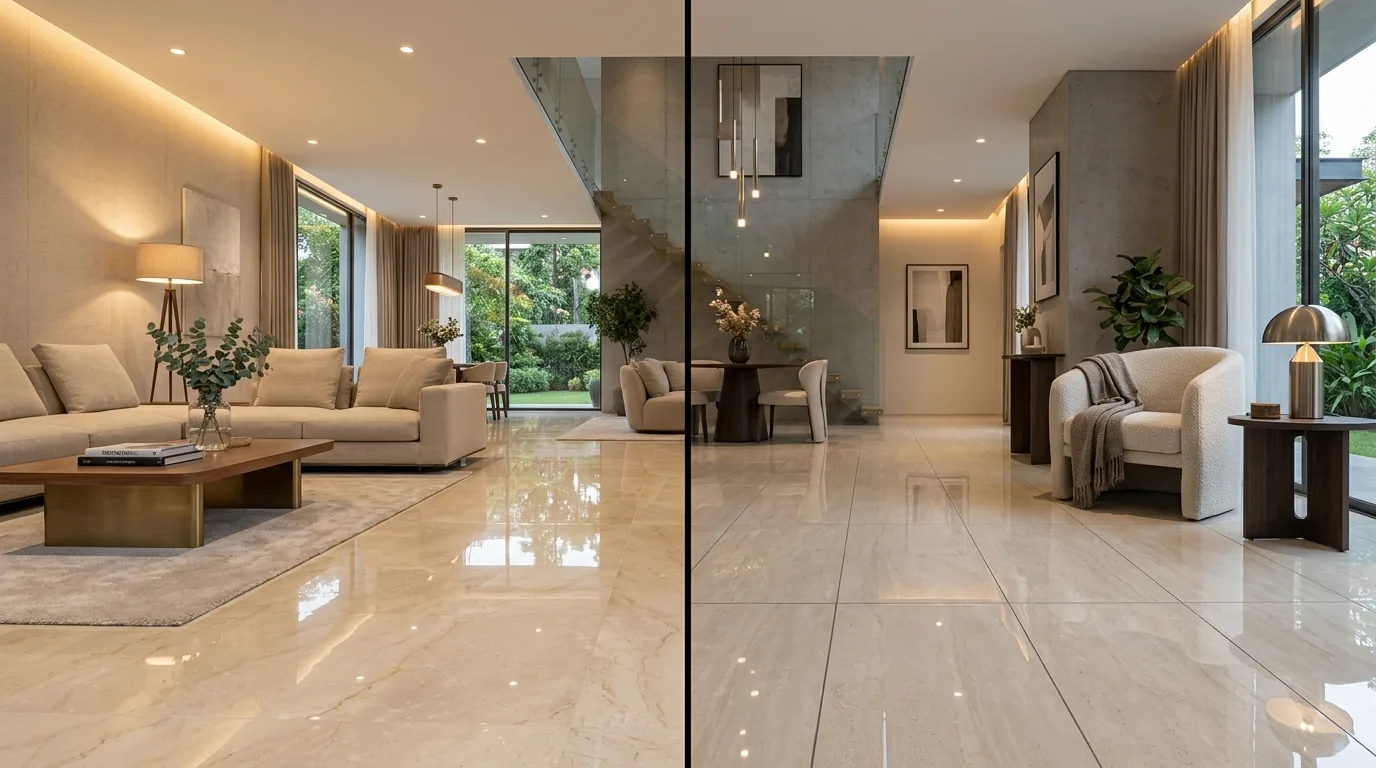
Split Architectural Interior Comparison of Natural Polished Marble Flooring vs Jointed Porcelain Tiles in Luxury Living Room
Side-by-Side Comparison: Natural book-matched marble provides continuous mirror reflection without joint grids; tiles feature repetitive prints separated by dirt-attracting grout lines. Architectural Visual Benchmark

Natural Geology vs. Industrial Ceramics: The Fundamental Difference

When designing a residential or commercial property in Pakistan, selecting between natural stone and manufactured tiles determines not only the initial construction budget but also indoor climate comfort and resale equity over decades.

Natural Pakistani Marble (Metamorphic Rock)

  • Composition: 100% monolithic recrystallized calcium carbonate formed under millions of years of tectonic pressure.
  • Unique Individuality: No two slabs are identical; authentic veins in Tavera, Ziarat White, and Boticina form natural luxury art.
  • Monolithic Depth: The color, veining, and pattern run 100% throughout the entire 16mm–20mm slab thickness.
  • Monolithic Flush Surface: Ground flat on-site with diamond abrasive pads, eliminating all tile lippage and joint ridges.
  • Thermal Conductivity: Absorbs interior heat and acts as an efficient geothermal heat buffer for bare feet.

Glazed Porcelain / Vitrified Tiles (Industrial)

  • Composition: Engineered slurry of silica, kaolin clay, and feldspar baked in high-temperature industrial kilns.
  • Surface Glaze: Color pattern is a microscopic digital inkjet print (0.1mm–0.3mm thick) applied to a clay substrate biscuit.
  • Repetitive Patterns: Factory screen prints repeat every 4 to 8 tiles, creating an artificial, rhythmic aesthetic in large halls.
  • Mandatory Grout Joints: Requires 2mm to 4mm spacer lines that attract dark grime, bacteria, and mop water discoloration.
  • Brittle Fracture Risk: Extremely hard but brittle; dropped metal objects shatter the top glaze, exposing the grey clay biscuit.

2026 Turnkey Cost Comparison: Marble vs. Tiles in Pakistan

A common misconception in the Pakistani real estate sector is that marble is vastly more expensive than tiles. In reality, when accounting for material purchase, cement sand bedding, tile adhesives, labor, and diamond polishing, local Pakistani marbles are frequently more economical than premium imported tiles:

Flooring Material Category Raw Material Rate (PKR/sqft) Fitting / Masonry Labor (PKR/sqft) Grouting / Polish (PKR/sqft) Total Turnkey Finished Cost (PKR/sqft) Lifespan and Residual Value
Budget Marble (Sunny Grey 12"×24") Rs. 75 – Rs. 95 Rs. 40 – Rs. 50 (Sand/Cement) Rs. 25 – Rs. 35 (Diamond Polish) Rs. 140 – Rs. 180 50+ Years (High Resale Value)
Mid-Luxury Marble (Tavera / Badal) Rs. 110 – Rs. 165 Rs. 45 – Rs. 55 (Sand/Cement) Rs. 32 – Rs. 42 (Diamond Polish) Rs. 187 – Rs. 262 50+ Years (Increases House Value)
High-End Marble (Ziarat White / Boticina) Rs. 180 – Rs. 340 Rs. 50 – Rs. 65 (White Cement Bed) Rs. 45 – Rs. 60 (Italian Crystallization) Rs. 275 – Rs. 465 Lifetime Luxury (Zero Depreciation)
Local Pakistani Ceramic Tiles (Master / Sonex) Rs. 120 – Rs. 180 Rs. 45 – Rs. 60 (Tile Bond Adhesive) Rs. 10 – Rs. 15 (Epoxy Grout) Rs. 175 – Rs. 255 8 – 12 Years (Glaze Wear)
Imported Chinese/Spanish Porcelain (60×120 cm) Rs. 220 – Rs. 450 Rs. 65 – Rs. 85 (High-Polymer Bond) Rs. 15 – Rs. 25 (Imported Grout) Rs. 300 – Rs. 560 12 – 15 Years (Chipping Risk)

Financial Takeaway for Homebuilders:

Sunny Grey and Tavera marble provide an authentic, solid stone floor at a finished cost of Rs. 140–260/sqft—significantly less than imported 60×120 porcelain tiles (Rs. 300–560/sqft). You get a lifetime natural stone surface that can be renewed indefinitely at a fraction of the cost of replacing chipped tiles. Calculate your exact square footage cost using our Interactive Cost Calculator.

Rooftop Flooring Under the Pakistani Sun: Why Marble Outperforms Tiles

With summer temperatures routinely crossing 44°C to 48°C in Lahore, Islamabad, Faisalabad, and interior Sindh, rooftop thermal insulation is a major architectural challenge. How do marble and tiles behave on roof slabs?

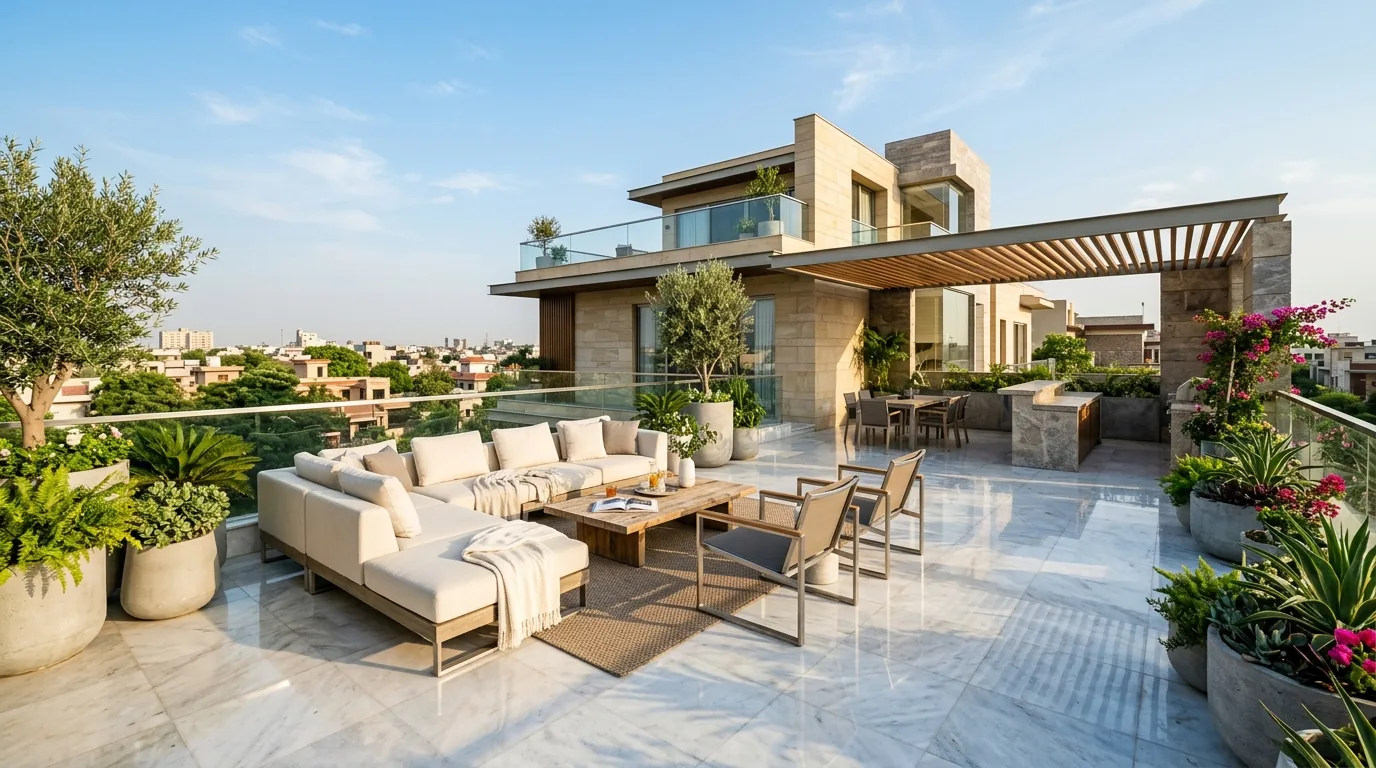
Luxury Villa Rooftop Terrace in Pakistan Paved with Heat-Reflective Natural Marble Floor Under Direct Sunlight
Terrace Performance: Natural white and light grey marble slabs dissipate solar radiation, preventing structural concrete slab heat transfer into top-floor bedrooms. Thermal Mass Advantage

Natural Marble Rooftops (Sunny Grey / Ziarat Rough)

  • Solar Reflectance: Light-colored natural marble reflects over 70% of solar radiation back into the atmosphere, keeping the roof slab substantially cooler.
  • Thermal Expansion Stability: Natural stone expands evenly across mineral planes, eliminating the risk of tiles popping up or buckling under extreme heat.
  • Rain and Water Drainage: Installed on sand-cement bedding with gentle slopes, preventing pooling and moisture leakage into roof slabs.
  • Weathering Resistance: Resistant to intense UV degradation; decades of sun and monsoon rains enhance its natural rustic patina.

Ceramic / Porcelain Rooftop Tiles

  • Heat Trapping: Glazed tile surfaces absorb intense solar radiation, turning the rooftop into a giant thermal radiator that bleeds heat into bedrooms below all night long.
  • Thermal Buckling ('Pop-Up'): Differences in thermal expansion between tile adhesive and the concrete slab frequently cause ceramic tiles to tent and shatter.
  • Joint Deterioration: Outdoor cement grout cracks within 1–2 summers under UV exposure, allowing monsoon rainwater to seep beneath tiles and rot waterproofing membranes.
  • Slick Surface: Becomes dangerously slick during light rains unless expensive abrasive matte outdoor pavers are specified.

Durability, Impact Resistance and The Chipping Catastrophe

In active Pakistani households with children, heavy cookware, and moving furniture, accidental impacts are inevitable. What happens when a heavy steel pressure cooker or metal iron drops on your floor?

If You Have Glazed Porcelain Tiles:

A dropped hard object chips away the brittle top glaze. The exposed interior is an unglazed red or grey clay body that screams out from across the room.

The Nightmare: You cannot repair it. You must chisel out the entire tile—frequently damaging neighboring tiles. Worse yet, because tile manufacturers change print batches every 6 months, matching the exact dye lot is virtually impossible.

If You Have Natural Pakistani Marble:

Because marble is solid stone all the way through, an impact chip reveals the identical color, calcite grain, and veining beneath.

The Simple Fix: A skilled stonemason mixes color-matched epoxy resin (Tenax) into the chip and polishes it flush with a handheld diamond pad. Within 20 minutes, the repair is completely invisible, and the structural integrity is fully restored.

Room-by-Room Architectural Recommendations

Architects do not choose exclusively marble or exclusively tiles; they deploy each material where its physics and aesthetics shine brightest:

Main Foyer and Living Lounge

Winner: Natural Marble. Large expansive halls look grand with continuous book-matched veins in Tavera or Boticina without gridlines breaking visual flow.

Grand Staircase and Riser Steps

Winner: Natural Marble Slabs. Single-piece gangsaw treads with smooth bullnosed edges and anti-slip grooving (Stairs Design Guide) far outperform jointed, sharp-edged tile steps.

Kitchen Countertops

Winner: Natural Stone / Granite. Boiling pots, chopping knives, and hot pans damage tile grout lines. Natural stone slabs (Kitchen Slabs) provide continuous, non-combustible durability.

Bathroom Shower Enclosures

Winner: Glazed Porcelain Tiles. Tiles excel in enclosed wet shower cabins where harsh acidic cleaners (Harpic) are frequently used, preventing acid etching on stone.

Rooftop Terrace and Car Porch

Winner: Natural Marble (Sunny Grey). High compressive strength accommodates vehicle loads, while natural UV reflection keeps roof slabs cooler in summer.

Bedrooms and Guest Rooms

Winner: Tie. Marble provides a cooling, timeless floor that increases room value; matte porcelain tiles offer easy daily maintenance for budget rentals.

Frequently Asked Questions: Marble vs. Tiles in Pakistan

Direct, objective answers to guide your construction budgeting and material selection:

Which option is cheaper for a 10-marla house: Marble or Tiles? +
For an average 2,200 sq.ft covered flooring area in a 10-marla house, opting for Pakistani Sunny Grey or Tavera marble (total finished turnkey cost: ~Rs. 350,000–500,000) is often cheaper than imported 60x120 porcelain tiles with high-grade polymer adhesives and imported grouts (~Rs. 650,000–950,000).
Does marble flooring get damaged by acids and lemon juice? +
Yes. Because marble is composed of calcium carbonate, direct exposure to harsh acids (like toilet cleaners or undiluted vinegar) causes chemical etching. However, applying a penetrating hydrophobic sealer during final diamond crystallization protects against stains and keeps the stone spotless with simple damp mopping.
Why do tiles pop up or crack on rooftops during Pakistani summers? +
Concrete roof slabs and ceramic tiles expand at drastically different thermal rates when exposed to 45°C sun. Without expansion joints every 10–12 feet, stress buckles the tiles off the slab ('tenting'). Natural marble breathes and expands uniformly with sand-cement mortar, preventing pop-ups.
Can dirty grout lines between tiles be cleaned or eliminated? +
Tile grout is porous cement that inevitably turns brown and moldy from mop water within months. Marble, on the other hand, is ground flat on-site and buffed into a continuous monolithic plane with color-matched epoxy, leaving zero open grout grooves for dirt to accumulate.
Which material adds higher resale value to a house in Pakistan? +
Natural marble carries far higher prestige among property buyers in DHA, Bahria Town, and Gulberg. Homebuyers recognize that tiles become dated in 10 years, whereas natural marble floors can be buffed to look brand new in 48 hours before listing a home on the market.
Is porcelain tile better than marble for bathroom floors? +
Yes, for enclosed wet shower cabins and bathroom floors, textured matte porcelain tiles are preferred due to high chemical resistance against acidic shampoos and bleaching agents. For vanity countertops and dry bathroom powder rooms, marble remains the premier luxury choice.

Get Factory-Direct Marble Slabs for Your Building Project

Compare sample slabs in person or request an instant cost estimate for your residential or commercial floor plan. We supply quarry-direct Tavera, Ziarat White, Sunny Grey, Badal, and Boticina marble nationwide.

Request Wholesale Quote 💬 Chat on WhatsApp

Quarry Direct Sourcing | Custom Cut-to-Size Slabs | Nationwide Dispatch Across Pakistan